(Antiphony, 2026)
The first line of Terracotta Fragments, “my mother’s head tumbling down the steps of the Colosseum”, introduces several of the book’s concerns: a physical commitment to discontinuity; a series of quilting points between the mysteries of antiquity and the ruthless familiarity of our world; an Orphic sacrifice of melody in exchange for knowledge of Hell, shredded and scattered between the Amalfi Coast and the JSTOR archives, the Hotel California and Ronald Reagan National Airport, which is also Hell. Benick’s fragments accumulate into a chant of glass shards on a cracked screen that spell out: all these images are going to kill you. But that’s okay, as one of the only moments approaching enjambment makes clear, “I write a quick list on the R train / three things worse than death— / dialysis, Red Delicious, eternity”.
—Emily Martin
Like the past is not even past, Eric Tyler Benick helps us feel again how fragment is not even fragment. Soundly and unsoundly, 11 after 11, Benick’s limbic-rattling articulations are fitted together by joinery only possible with an urushiol lacquer, critical collagen, and the poet’s inimitable “marmalade wisdom.” With his “speedo bursting with love for [his] century,” Benick, re-centers on the wheel ages of terraformed metadata, true and hallucinated artifacts of self, culture, life. We can all benefit immensely from this model of heroic imagination, which Benick uses to reanimate latent linkages to the whole (mess), discovering in baked earth interior chutes to distant specifics— “blowjobs in driveways across Tennessee,” a “jheri-curled youth riding a rooster”—all the while, “each chamber of his heart a rabbit in heat.” To quote poet and potter M.C. Richards: “When is a pot not a pot? What is freedom? What is originality? Are there rules?” Eric Tyler Benick, visionary pot-piece-ponderer refuses answers, but sings new phrasings of the melody with love, fury, and a transcendently dark sense of humor.
-Ian U. Lockaby
Terracotta Fragments conjures a museum, line-by-line, of ancient objects alongside present desires, perceptions and failures in a gorgeous and disquieting blur of sensory artifacts. Ekphrastic flickers, gifts of broken shards, these poems offer a whirl of precise and often hilarious gestures, where the surface of each line multiplies in a deep array of ache: "the beautiful world begging me to destroy it". It is in these moments where the overwhelming dazzle of broken sensation drifts across the bounds of these poems. Eric Tyler Benick immerses us within this present of impasse, his poems pressing against a moribund order ready to shatter, "barbiturates of a slow and deliberate touch".
—Geoffrey Olsen
(Long Day Press, 2024)
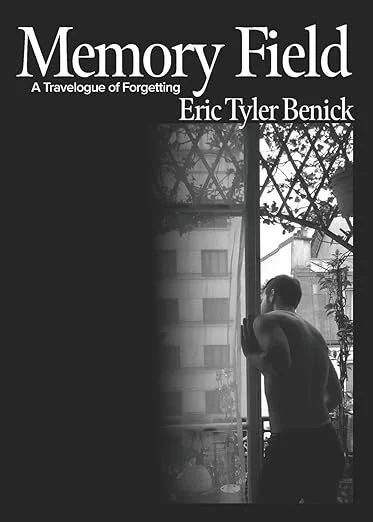
In Memory Field, Benick recalls objects of consciousness as altered by the materials of space and time and examines the social and ontological imperatives of what it means to be a body at any given moment. A "travelogue of forgetting" in the Proustian sense, Benick's text embraces the impossibility of accurate remembering and concedes to the liminal overlap of fact and fiction. In distilled fractions of experience, Memory Field holds the place where life once was - in ruin, in metonym, in loss.

(Beautiful Days Press, 2023)
A thicket of variables flashing with relation. Lit with dark. Fabular and renegade. Synaptic and sounding. With a desperate vision. At the edge of life. 'the fox hunts' is a vast-little book of lyrical implosions, vanishings and crises, catastrophe and absurdity and secret beauty all at once, “in the war on every corner.” I go to Benick’s work for this audacious sound—critical to me. How everywhere here are new structures for thinking about processes of tyranny but also the tender, secret thing inside the throat.
—Aracelis Girmay
Reading 'the fox hunts' brought to mind Viktor Shklovsky’s saying that the purpose of art is to make the stone stony. Eric Benick makes the fox foxy in his hyper-stylized, fabulistic register. He uses the subversive serial form to give shape to a mediated reality of the poet as fox and wearer of fox suit suavely showing us the sinkholes in our national consciousness— “I’ve just read the latest litany / from the bald eagle’s dispatch / renouncing himself as metonym / and shouldn’t we all.” The mutiny is coming from inside of the house. Bravo to his sense of humor and his delight in the alliterative and other sonic properties of language which gives us the bravado to hang out with the kinds of contradictions we live with as citizens.
—Stacy Szymaszek
We—if I may—us denizens, who wear and devour terrible, horrifying, and endless symbols that compose our waking life, in and out of consciousness, all of us, us—people—well, I’ll say first that I do hesitate to “admit” that there is delight in this book, but only in considering the historical actions of delight associated with the word, with the feeling. Those who feel bombarded by chatter delight in the weight of silence afforded beneath the surface of a liquid. I do feel undone after reading this book, and I did find delight in cleaving meanings from words, words from feelings, action from gestures, ideas from “the future.” It beckons a drippy, slightly mutilated animal form, dharmic and hot, slightly uneasy, but aha! this milieu is suddenly essential, suddenly comforting. “By now I’m sure we’re all tired of this great American slapstick.” Truly. But, to quote an obvious hero of Benick’s, if you’ve ever “mistakenly taken your house’s thermostat for a dial with which to focus the windows…then you know what I’m talking about."
—Ryan Skrabalak